

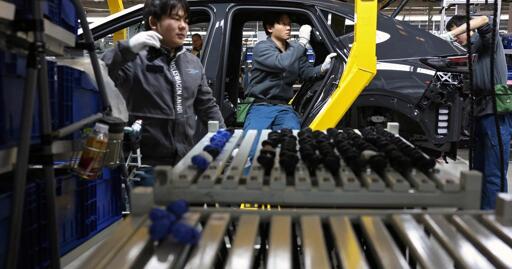
IMF crying about being outcompeted
https://en.wikipedia.org/wiki/Dumping_(pricing_policy)
In case you wanted a thorough explanation on why what China is doing here is bad for everyone except China.
It’s only bad for other countries if they let it be, any country can subsidize their own manufacturing if they want. Why would China have any obligation to run their economic policy to benefit the USA? Insane level of entitlement.
This statement makes no sense. China’s mercantilism - pushing for trade surpluses in practically all industries - wouldn’t even work if pursued by all countries (a trade surplus for everyone is logically impossible, and the attempt doesn’t end well as we have seen in Europe 300 or so years ago).
Beijing is subsidizing some sort of a zombie economy as many companies would long be shut down without massive state subsidies that go well beyond what can be considered reasonable. In the EV industry, for example, only 15 of 129 Chinese EV brands are expected to be profitable by 2030, according to a report from last year.
The US and China are artificially creating economic imbalances, it’s just that one is doing it mainly by tariffs and the other by deliberately producing oversupply.
[Edit for clarity.]
Why would the goal be for “everyone to have a trade surplus”? More like, everyone retains manufacturing capability for at least the most critical things, and speculation which is not even grounded in at least some kind of industrial base is somewhat disincentivised.
Right, and it follows to other sectors too, from mining to agriculture most of all. The IMF and WTO are always trying to get countries to kill their subsidies to their agriculture, and when they do emergency loans they will force them to get rid of it, their farmers go out of business, and they are at the mercy of buying food.
Countries need to keep their own capacity, this idea that all subsidies are bad and let the market decide is preposterous, and any true free market with no controls degrades into a monopoly or oligopoly gouging everyone. Capitalism without controls doesn’t work, capital is too greedy to do what is in their own interests let alone that of society.
How are historically oppressed countries supposed to afford that?
Yeah, the IMF, defender of historically oppressed countries. Lmao.
The IMF says whatever random shit benefits their consituents. Sometimes that’s also morally right, but usually not. If you’re gonna take a braindead position against them for signalling reasons then fair enough, but the fact that you can’t even come up with a basic reason why they’re wrong should clue you in.
This is a pretty standard orphan-crushing manuever and I think both sides are kinda cringe. It is what it is.
I replied with several specific arguments elsewhere in this thread, including a further on this comment chain.
How does this make what he said wrong?
Not directly, it’s just a prod to think about the subject a bit more. The IMF wouldn’t push for this if it was of benefit to anyone but the USA and maybe Europe.
The real answer is that, if by “historically oppressed” they mean “poor”, labour costs and purchasing power there are both lower and so it will be within their means to subsidise the manufacturing that they themselves are able to consume, probably even at a lower price than China. If they’re historically oppressed but actually have money now then obviously they can just use that.
To be clear I’m mainly referring to African countries, though there are others too. Any country that isn’t presently industrialised will be prevented from developing their own industrial capacity by their Chinese competition (assuming the prices are correctly fixed). In general I think it’s bad because the lack of internationally dispersed manufacturing ownership contributes to unequal power relations between nations (i.e. imperialism and neocolonialism). A highly protected world-factory in China seems to present a viable model for world hegemony that could replace the financialist model of the United States. Both are bad.
I think they will also have to subsidise or otherwise incentivise manufacturing in their own countries to develop it but like I said their labour costs are lower than in China so they have some competitive advantage there already. I agree it’s bad that the capacity is not more distributed but I don’t believe that China’s internal subsidies will prevent any country from doing this, only post industrial countries which already have the money to buy large amounts of Chinese exports.
Why would USA have any obligation to not tariff subsidised Chinese goods in return?