What’s the point of being glad that a tyrant is dead if the country gets even worse than under him? If the reason you want the guy dead is because of how bad the country was under him, shouldn’t you prefer things not getting worst over the guy dying and things getting worse?

Marxist-Leninist ☭
French 🇫🇷
he/him
Study physics ⚛️
- 53 Posts
- 415 Comments
Joined 3 years ago
Cake day: June 10th, 2023
You are not logged in. If you use a Fediverse account that is able to follow users, you can follow this user.
Can you point to me where in the constitution does it say that?
in famous thought experiment, named Trolley problem, do you call yourself murderer (genocider) if you decide to push the lever?
Yes, even if it’s “justified” or “the most moral choice” or “the lesser evil” knowingly killing someone is still murder.
Incidentally, the trolley problem is a poorly made though experiment. The fact that the only way it has to deal with “troll answers” that refuse its attempt to impose a false dichotomy is to say “that’s not allowed” or “just answer the question” should be proof enough that it doesn’t apply to real world “dilemmas” even as a metaphor.
 4·6 months ago
Not sus at all that you have all of these articles saved and ready to go for this gish-galop nonsense
Indeed it’s not, it’s just good debate and learning practice to have relevant sources on various subjects saved up. You should consider doing it too, it might help you not look like you have nothing to push back with like now.
I’m still waiting on you to drop the data you think I didn’t pick btw.
So you don’t, as I suspected. Just to clarify since clearly you aren’t even going to pretend you checked the link I gave you, what I linked was the wikipedia article about Jews who collaborated with the Nazis during WW2. All this to say, yes, you can be Jewish and a Nazi. These things aren’t as mutually exclusive as you peoples like to pretend they are, and the fact that you ignore all the examples of Jews who were Nazis is arguably, again, the very cherry picking you accused me of.
Meanwhile you have yet to provide the data that I supposedly omitted according to you.
Go ahead and link the sources that show I’m wrong that I didn’t pick then. Surely you better rebuttals than “ZeLeNsKy Is LiTeRaLly JeWiSh” right? Because if not, I’m afraid you would be the one doing cherry picking here.
If it’s sources you want then ho boy do I have a bunch for you to check out:
Nazis in Ukraine
Ukraine’s Nazi problem is real, even if Putin’s ‘denazification’ claim isn’t Nazi Symbols on Ukraine’s Front Lines Highlight Thorny Issues of History Commentary: Ukraine’s neo-Nazi problem Torchlight parade in Kyiv honors Nazi-linked nationalist 1000 in Torchlight March in Kiev Honoring Nazi Collaborator Torchlight parade in Kyiv honours Nazi-linked nationalist Trudeau and Zelensky give Ukrainian Nazi war veteran standing ovation in Canadian parliament Canada House speaker apologizes for recognition of veteran who fought for Nazis Ukraine’s far-right children’s camp: ‘I want to bring up a warrior’ Canadian Parliament gives WWII Nazi standing ovation | Al Jazeera Newsfeed [[Archived - Teacher in Kiev “When the break bell rings, the children here speak Russian”]] Hawkish Pundits Downplay Threat of War, Ukraine’s Neofascist Ties Nazi collaborator monuments around the world - The Forward How Nazi Collaborators Are Celebrated in Wartime Ukraine - New Glo
The US-backed Maidan coup and US & Ukraine-supported fascist paramilitary attacks on eastern & southern Ukraine:
Reuters, 2014: Leaked audio reveals embarrassing U.S. exchange on Ukraine, EU
Leaked recording between Nuland and Pyatt: audio | transcript
Counterpunch, 2014: US Imperialism and the Ukraine Coup
BBC, 2014: Ukraine underplays role of far right in conflict Human Rights Watch, 2014: Ukraine: Unguided Rockets Killing Civilians
Consortium News, 2015: The Mess That Nuland Made Assistant Secretary of State Victoria Nuland engineered Ukraine’s regime change without weighing the likely consequences.
The Hill, 2017: The reality of neo-Nazis in Ukraine is far from Kremlin propaganda
The Guardian, 2017: ‘I want to bring up a warrior’: Ukraine’s far-right children’s camp – video
WaPo, 2018: The war in Ukraine is more devastating than you know
Reuters, 2018: Ukraine’s neo-Nazi problem
The Nation, 2019: Neo-Nazis and the Far Right Are On the March in Ukraine
openDemocracy, 2019: Why Ukraine’s new language law will have long-term consequences
Al Jazeera, 2022: Why did Ukraine suspend 11 ‘pro-Russia’ parties?
Jacobin, 2022: A US-Backed, Far Right–Led Revolution in Ukraine Helped Bring Us to the Brink of War
Consortium News, 2023: The West’s Sabotage of Peace in Ukraine Former Israeli Prime Minister Bennett’s recent comments about getting his mediation efforts squashed in the early days of the war adds more to the growing pile of evidence that Western powers are intent on regime change in Russia.
Internationalist 360°, 2022–2024: History of Fascism in Ukraine: Part I, Part II, Part III, Part IV
NYT, 2024: U.N. Court to Rule on Whether Ukraine Committed Genocide
You do know you can simply type the headlines in google to know if they’re real right?

How about having government sponsored Nazi youth boot camps[1], large neo-nazi gatherings honoring nazi war criminals without consequences[2], the military, both regular and militias, harboring nazi simbology[3], building monuments and exhibitions honouring nazi war criminals and denying their war crimes[4], Zelensky participating in a standing ovation to a Waffen SS veterent[5]? Does that scream Nazi loud enough for you?
‘I want to bring up a warrior’: Ukraine’s far-right children’s camp – video ↩︎
Torchlight parade in Kyiv honors Nazi-linked nationalist, 1000 in Torchlight March in Kiev Honoring Nazi Collaborator, Torchlight parade in Kyiv honours Nazi-linked nationalist ↩︎
Nazi Symbols on Ukraine’s Front Lines Highlight Thorny Issues of History, How Nazi Collaborators Are Celebrated in Wartime Ukraine - New Glo ↩︎
Nazi collaborator monuments around the world - The Forward, How Nazi Collaborators Are Celebrated in Wartime Ukraine - New Glo ↩︎
How Nazi Collaborators Are Celebrated in Wartime Ukraine - New Glo, Trudeau and Zelensky give Ukrainian Nazi war veteran standing ovation in Canadian parliament, Canada House speaker apologizes for recognition of veteran who fought for Nazis ↩︎
Waiting for the wave of angry libs accusing the Atlantic Council, Politico, the BBC and Freedom House of “Russian propaganda”
Literally pretty much everything Lenin wrote about Trotsky was him calling Trotsky an idiot who has no clue what he’s talking about half the time and was generally a nuisance to their party work and organizing. In what world was Lenin better friend, or friend at all, with Trotsky than Stalin?
The imperials took inspiration from their family tree to make their system I see.
I love that the same
 and
and  we use today for communist memes were passed down to us by soviet comrades.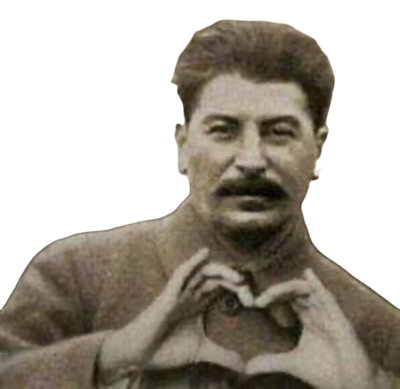


 👈 Like this
4 peoples recount to the press the time they were stranded on a small uninhabited island. 3 of them talk about how hard the 4th made it for them because he would eat almost everything that they fished, hunted and harvested by himself and leave only leftovers for the 3 and didn’t fish, hunt or harvest anything himself.
An economist cut them off and says that, actually, the 4th did them a favor because he generated almost all the demand for fish, meat and fruits and without him they wouldn’t have had a job on the island.
Who said that it was intentionally made famine with the goal of killing people? And where?
That’s the “mainstream” narrative so I assumed it was what you were arguing, sorry if it wasn’t.
Are you hung on the original commenter calling it “mass murder” and your point is that it wasn’t premeditated?
Essentially. Yes.
Would the governing body of PRC in 1962 attributing the famine to government errors convince you otherwise? Would the Chinese government 20 years later confirming the same convince you?
I’m not sure where you’re going with this. That the famine was accidental and (in part) caused by bad policies and mismanagement is what I’m saying happened. You’re agreeing with me there.
If not, can you imagine a fact that would convince you? What is it?
If you think the famine was accidental but the government’s bad policies caused it/made it worse, I already agree.
If you think that the famine was intentional and the government was trying to kill peoples by starvation, I would need proof that they at least discussed it internally in order to be convinced. Leaked internal documents, testimony from peoples who were there (and can prove that they were), recording of meetings between party officials, that kind of things.
I’m sorry, but why would that matter? We tend to judge people by their actions, not their intent, when it comes to mass deaths.
Right?
Right?
Maybe it’s my autism but dismissing a relevant question by implying that the person who asked it is immoral/unempathetic for even asking it seems pretty defensive to me, and is a non-argument regardless.
Literally what the first commenter gave - there was a widespread famine in China, it’s caused by Mao agricultural policies.
Now that one is on me, I could have worded that better. By cause-effect relationship in this context I meant the cause who’s effect was that the government chose to take whatever course of action you believe is responsible for the famine. Peoples take decisions for reasons, bad reasons sometimes, yes, but reasons nonetheless.
It’s not about agreeing with the reasons, it’s about coherency. That an entire government, a group formed of thousands of peoples, would act all in concert with no motive, especially for a project on such a large scale and which would take so many resources, is nonsense. If you can’t present either proof that they really took the conscious decision to manufacture a famine or a motive to explain why they would want to do that, the claim that the famine was intentional is extremely dubious at best.
Also, speaking of a government’s actions as if only the one person at the top was to blame is something peoples trying to speak about politics and history seriously should avoid.
What are you contesting here? There was no famine? Famine is the narrative? Or that it wasn’t caused by policies but by… What? Weather? Weather was good.
There was a famine. But it was not man made with the purpose of killing a large portion of the population, again, as the other commenter pointed out, why would they do such a thing? And why did they stop doing it? It makes no sense.
The famine was the produce of a great number of different factors, inefficient and backward agricultural methods, bad weather, compound effects of WW2 + the Chinese civil war, mismanagement, trade embargoes, etc… But others could explain it better than I can.
An other point we disagree on is the number of deaths from the famine. Numerous western academics intentionally inflate the death tolls of countries ruled by communist parties, most infamously “the black book of communism” and the “victims of communism foundation” who literally count Nazi invaders killed by the red army and peoples who could potentially have been born but weren’t as victims of communism.
I don’t understand your point, please clarify it, in a way that isn’t just calling your interlocutors stupid or defensive.
I called you defensive but I did not call you stupid, nor did I imply it.








Almost surely false. I seriously doubt it’s possible to train a modern multy-billions parameters LLM with less than 2 dozen million prompts, even if it’s 16M each, let alone if it’s 16M combined.